

Accepting Our Quirky Brains
A Q & A with Writer and Editor Lynn Shattuck

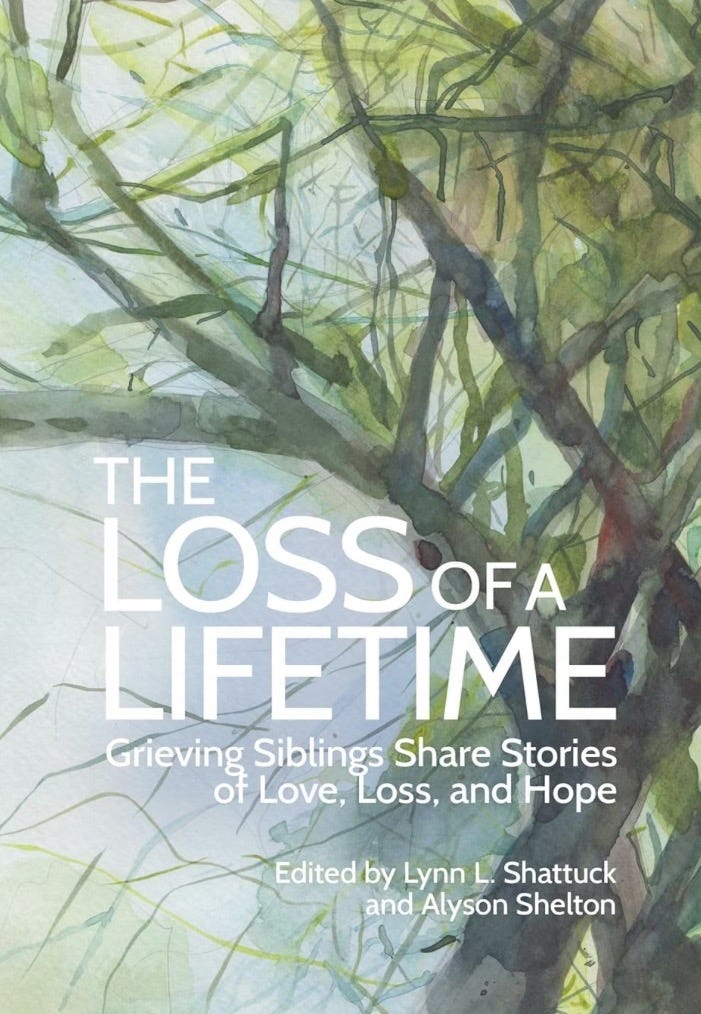
I was introduced to Lynn Shattuck by a mutual friend who thought we’d have something in common. We did. Probably more than she realized. Of course, we both have ADHD. We’re writers, editors, book coaches, and anthologists. And we’ve each experienced sibling loss, which is the subject of an exquisitely beautiful anthology Lynn coedited with Alyson Shelton, The Loss of a Lifetime: Grieving Siblings Share Stories of Love, Loss and Hope.
She not only writes frequently about grief, she’s also facilitated writing groups for people experiencing cancer or grief, co-facilitated a support group for grieving teenagers, trained crisis response volunteers, and educated police officers about how best to deliver death notifications.
Lynn has contributed to The Huffington Post, Human Parts, Vice, The Fix, and Al Jazeera, and has been a columnist at Elephant Journal for ten years. Here, she shares her ADHD journey and talks about the way it influences her writing career.
Find her on Substack, on her website, and at Loss of a Lifetime.
Before we get into a conversation about ADHD and creativity, tell me about your work-in-progress, or, if you’re not working on a new writing project now, your most recent.
In true ADHD fashion, I’m juggling a couple of different memoir/essay projects at the moment. In June, my co-editor and I launched The Loss of a Lifetime: Grieving Siblings Share Stories of Love, Loss, and Hope, an essay collection about sibling grief. We’re really proud of it.
When did you discover you had ADHD and what prompted or led to that discovery?
I first suspected ADHD when I saw an Oprah episode about it when I was 20. But it wasn’t until my mid-40s that I learned more about it—for instance, that people with ADHD can be easily overstimulated, which explained why I hate going to the mall. Or that our ability to regulate emotions is affected by ADHD, hence a lifetime of feeling battered around by my own moods, as if my feelings were strong weather systems.
I didn’t actually get diagnosed, though, until I was 45—right before the pandemic. My dad had just died and I was charged with a lot of extra tasks that devoured my executive functioning capacity. That prompted me to seek a diagnosis and try medication, which I always worried would amp up my anxiety (it totally didn’t).
Would you describe yourself as primarily inattentive, hyperactive, impulsive, or a mix?
Inattentive with a splash of impulsivity that’s been tamed over time.
Did you expect the diagnosis—was it not surprising—or was it a lightbulb moment that suddenly made everything seem to make sense? Do you think of your diagnosis as a sort of watershed moment that divided life into the before knowing and the after knowing?
For me, it was a slow illumination that took place over time. Like turning on a light with a dimmer switch incredibly slowly.
What was your initial emotional response to discovering you had ADHD? Has that changed over time?
Initially, I felt relief, especially once I started medication and experienced the positive effects of it. I remember scooping up dog poop in our yard and feeling like I could just keep scooping until the task was done—it was a revelation!
Later, as I processed how much my self-esteem had eroded because my ADHD was undiagnosed for so long, grief bubbled up.
Do you consider the experience of being diagnosed with ADHD transformative in any way?
Yes. Understanding that I wasn’t just “not living up to my potential” or lazy softened me to my younger self.
What’s the least and most helpful advice you’ve been given?
“Just make a schedule and stick to it” is the least helpful. Learning to reparent myself with gentleness and care—while dripping with cheesiness—actually works.
Do you have a writing routine or do you find a routine to be incompatible with your experience of ADHD?
I’m currently in a generative writing group that meets weekly. It’s new for me to write with others and to share that fresh writing with them, but it’s working.
Once you knew you had ADHD, did you alter or attempt to alter your writing process in order to accommodate your new understanding of the way your brain works?
I think at first I felt like I needed to make up for lost time and get as much done as quickly as possible. Over time, I’ve learned that slow and steady, while not nearly as sexy, is more sustainable and yields better results.
Do you believe ADHD gives you an edge creatively? If so, in what ways?
I don’t know if this is ADHD or not, but I do have a sharpened ability to make mental connections that others might miss and to spot metaphors even when I’m not looking for them.
What aspects of writing does ADHD complicate or make more difficult? (For example, choosing or sticking with a topic, keeping a writing routine) Do you have a top two or three or five list of the biggest challenges?
Battling resistance can feel impossible. Also, sticking to a project when it’s not flowing easily. Having the stamina and patience to keep returning to a project when I don’t know where it’s going or if it will ever become something other people would want to read. Getting stuck on some aspect of the project and freezing up is another challenge.
Have you learned anything that helps with those issues or developed your own workarounds?
I’ve learned that being gentle with myself yields better results than mentally kicking my own ass. Having an accountability partner is also a huge help. And working on the sibling loss anthology with my co-editor, Alyson Shelton, was a gamechanger—she helped me move out of my perfectionism paralysis and keep moving forward until we had an actual book.
Is there anything you’ve tried that has not helped and if so, why?
Trying to stick to a stringent schedule of writing for several hours a day has never worked for me.
Do you believe ADHD has affected your overall career as a writer?
Yes, absolutely.
If you were late diagnosed, how do you think your career might have been different if only you’d known you were neurodivergent? If you do believe it would be different, you experience any feelings of grief or regret about that?
Yes, I definitely feel like a late bloomer who’s taken A LOT of detours on my writing journey. I do feel grief and regret for that, but most days I’m able to stay in the present and be excited about what I have been able to accomplish despite a lot of obstacles and eager to see what emerges next.
All writers face rejection, and most on a regular basis. And while it’s not fun for anyone, people with ADHD often experience it acutely. If that’s your experience, how do you cope? What keeps you putting yourself out there?
Sheer stubbornness. Normalizing rejection. Having a community of other writers who believe in me.
Are there any self-care practices that for you ease difficulties associated with ADHD in general or with writing in particular?
I’ve recently returned to writing “morning pages” (a la Julia Cameron’s The Artist’s Way). In my writing group, we incorporate a brief meditation and a juicy writing prompt, both of which help a lot.
What do you think are the biggest misconceptions people have about ADHD?
That it only affects our attention span and not a whole host of other executive functioning areas, like emotional regulation, prioritization, and organization.
What are a few items on your dopamine menu? What gives you hits of joy or excitement?
Reading beautiful writing. Writing in community with inspiring, sensitive, empathetic writers. Live music.
Finally, if you could give up your ADHD, would you?
Nah. I’ve grown to appreciate my quirky brain, with all of the struggles and gifts it comes with.
Need help developing your story? Guidance in crafting queries and proposals? Or strategies and workarounds for the challenges of writing with ADHD? Please get in touch!
It's delicious to feel so seen when reading about someone else's life. :-)
Such an insightful interview. To finish a task. To keep on scooping anything until it's finished. I wonder what that would feel like. At this point, I doubt I'll ever know.