

Like a Formula One Car
A Q&A With Author, Advocate, Educator Katie Rose Guest Pryal
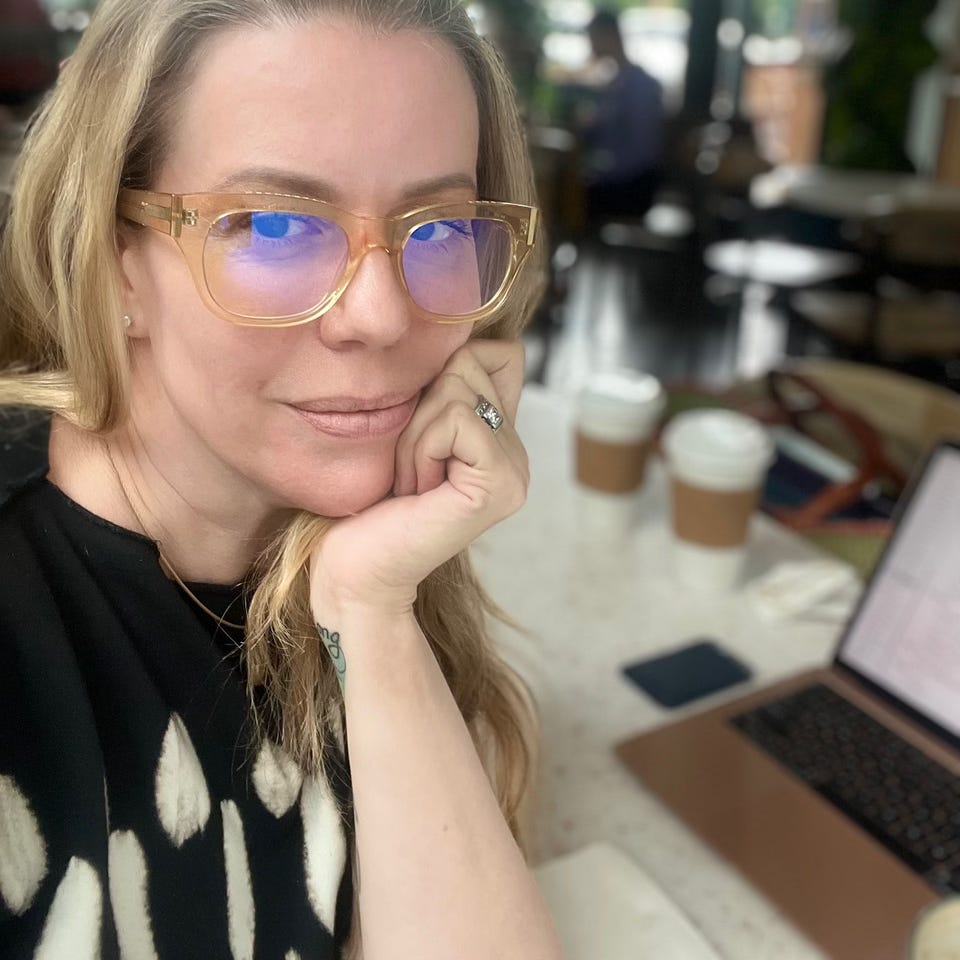
If you haven’t already rejected the myth that people with ADHD are underachievers, Katie Rose Guest Pryal will persuade you. And if you think your ADHD keeps you from accomplishing your vision, she’ll inspire you. She’s a bipolar-AuDHD (Autistic+ADHD) mother of two AuDHD children, a lawyer, a professor, a competitive equestrian, an expert in mental health and neurodiversity, and an award-winning author of more than 15 books, including Your Kids Belong Here: An Insider’s Guide to Parenting Neurodiverse Children (championed by Temple Grandin) and A Light in the Tower: A New Reckoning with Mental Health in Higher Education. Katie Rose speaks to audiences all over the world, combining personal stories and science to promote acceptance and understanding of neurodivergence—to advocate for belonging and inclusion.
Learn more about her at katiepryal.com; find her letter, “The Misfit Manifesto” at themisfitmanifesto.com; follow her on instagram, and look for her books at pryalbooks.com.
Before we get into a conversation about ADHD and creativity, tell me about your work-in-progress or, if you’re not working on a new writing project now, your most recent.
I’m so excited about my current book. It’s titled An Autistic Girl’s Guide to Horses: Horses, Horse Girls, and the Lost Generation of Autistic Adults. It’s a hybrid literary memoir; I started riding horses again at the exact same time that I was diagnosed with autism and ADHD.
There is a “lost generation” of autistic adults. As prominent psychologists wrote for The Lancet in 2015, millions of adults—predominantly women and people assigned female at birth (AFABs)—grew up undiagnosed because diagnostic criteria were built around disruptive white boys who liked trains. Research shows that 80% of autistic women remain undiagnosed past the age of eighteen. Now, as adult diagnoses surge, these women are reckoning with childhoods they finally have language to understand: the bullying, the social confusion, the obsessive interests that were mocked rather than recognized as neurodivergent traits.
One of those traits, it turns out, is loving horses. According to psychological research, horses are among the most common obsessions of autistic girls. When you hear that horse girls are “weird,” it’s true—so many of us are neurodivergent, which is basically a synonym for “weird” in our ableist society. No book has yet put these two things together: the explosion of late autism diagnoses in women and the deep, documented connection between autistic girlhood and horses. Guide to Horses explores this connection through my own journey.
When did you discover you had ADHD and what prompted or led to that discovery?
The answer is the most Gen-X story ever. As I was writing my last book, Your Kid Belongs Here: An Insider’s Guide to Parenting Neurodiverse Children (Johns Hopkins, 2025), I was interviewing my mother about what I was like as a kid. She said, “ … after the psychiatrist diagnosed you with ADHD…” and I said, “What?!” So yes, I was technically diagnosed when I was in first grade—and for a girl to get that diagnosis in the 1980s was a big deal since mostly ADD/ADHD was reserved for white boys of a certain presentation. Turns out my parents did nothing to support or treat my ADHD; they didn’t even tell me about it. Yeah, you had ADHD, we did nothing, you seemed fine, look at you now, that hose water you drank must have helped. LOL. I’m not angry; at this point it’s funny. But I definitely suffered for it because I had no support and felt like a weirdo.
Would you describe yourself as primarily inattentive, hyperactive, impulsive, or a mix?
I was hyperactive as a child—I’ve probably learned to mask that these days. I’m still impulsive, but I’ve built protective measures to help me from acting impulsive in ways that cause me pain. The problem there is that I second-guess my decision-making constantly. It would have helped a lot to have someone teach me these skills rather than muddling through on my own. I struggle with decision paralysis as much as the next ADHDer, but I am not inattentive.
Do you have a writing routine or do you find a routine to be incompatible with your experience of ADHD?
I suffer from the “too many projects” problem. There are so many things I want to do, and I want to finish them. As writers, especially writers of books, it can be hard to stay focused because there aren’t real deadlines unless you already have a book under contract. So that is one of the things I do—I try to get my books under contract as soon as possible so that there is the outside pressure. Routines are definitely helpful to me. I’m very organized, and if there is clutter on my desk, for example, I find it very, very distracting. My main challenge is to avoid working on the lesser-important things that are quicker to accomplish so that I can focus on the bigger things that I need to work on every day, like writing my (current) book manuscript. If I don’t write, at least a little, every day, then I will lose track of where I was and have to spend half my time catching up again, which is a huge waste of time and effort. The longer I stay away from a project, the bigger that catching-up task becomes, and then I just avoid it altogether.
To summarize, there are three things I (try) to do first thing every morning: (1) Write in my notebook my thoughts about the day. This activity is very soothing for me and allows me to brain-dump and therefore focus better. (2) Get out my to do list (I use paper and pen in the same notebook) and write this one thing: “Write [Book], [Date].” That way, I have an actual item to check off every single day that is writing in my book. There’s no page count required, or any other numerical goal. Sometimes I just open the document, write a sentence, and close it. The low pressure allows me to keep going.
Do you believe ADHD gives you an edge creatively? If so, in what ways?
I get told, all the time, by people from different areas of my life, how “productive” I am. I don’t think I could hate that word more. It is capitalist garbage. I’m churning out word-widgets for the machine or something. One thing is true, though. I can, indeed, sit down and write a book, fast. I think it is because of my AuDHD in many ways, in part because I had to overcome challenges on my own without knowledge of my diagnoses—and the tools I created serve me very, very well. For example, when I get stuck, I dictate. I can dictate an entire book chapter in maybe twenty minutes. Learning how to dictate took a bit, but once I did, it changed everything. I also have the hyperfocus gift, so I can sit down and write for three hours, and emerge with 5000 words. Which I know is a lot.
But what people don’t realize when they talk about how productive I am—when they give me that “compliment”—is the cost. I joke that I’m like a Formula One car: really high-performance, and really delicate. I’m always on the edge of burnout. Of overwhelm. Of all of the things that we struggle with. Some days, I don’t get out of bed, and honestly, it’s the best thing for me.
I am lucky because I have a hobby that forces me out of my head. You cannot ride a horse around a jump course with your focus elsewhere. (I compete in showjumping and dressage.) That’s a surefire way to end up in the dirt. Horses are amazing creatures. They’re goofballs who are also magnificent. Kind of like us.
All writers face rejection, and most on a regular basis. And while it’s not fun for anyone, people with ADHD often experience it acutely. If that’s your experience, how do you cope? What keeps you putting yourself out there?
Rejection used to DESTROY me. [I definitely have rejection sensitive dysphoria (RSD).] My first memory of a super-painful professional rejection went like this: the rejection happened—I was invited to interview for a professor job, made to feel like I was a shoo-in, then rejected. Look—it happens, I know that. I sobbed, feeling like my career was in the toilet (it kind of was) and also feeling helpless.
And then, literally an hour later, I got up, grabbed all of the course materials I had generated over the years for a course I created for my institution, and turned them into a book proposal. I sent it to a big textbook publisher, it was accepted, and that was my first book. I was pregnant with my first kid at the time, so this must have been 2008? But taking that rejection energy and turning it into my first ISBN taught me an important lesson—that I have more control over my destiny than I think I do. Not “control,” perhaps, but that I can put something good out into the world without the permission of gatekeepers. And in the end, I was much, much better off without that job and with that book, because it led to the most well-paying book I’ve ever published. It literally started the ball rolling on my professional writing career.
I have ten stories like this that I could tell you without thinking much about it, but they all go the same way: I’m rejected from something I think I want. I grieve, a lot. I take that grief energy and turn it into something generative. And every time, what comes out of the rejection is better than what I lost.
What are a few items on your dopamine menu? What gives you hits of joy or excitement?
As an author, there aren’t a lot of dopamine hits when writing a book. The process is just so long; it’s a tortuous experiment in delayed gratification. So, while I write books, I also write short pieces for magazines and such. Seeing my name in a byline, having my writing out there in the world in a more immediate fashion, helps me keep going.
Finally, if you could give up your ADHD, would you?
Of course not.
Sign up on Katie Rose’s website to get a free copy of A Brain-Based Guide for Writers Who Want to Break Through Anxiety and Perfectionism.
Need help developing your story? Guidance about crafting queries and proposals? Or strategies and workarounds for the challenges of writing with ADHD? Please get in touch to learn more about my editing and coaching services! If you need help managing the broader life challenges posed by ADHD, find a certified ADHD coach at ACO, CHADD, ADDCA, or PAAC.
Thanks for having me, Kate.
What a wise and enriching exchange. As a longtime teacher, I know that ADHD has nothing to with intelligence, let alone creativity!