

Seeing All the Things, All at Once
A Q&A with Photographer Katie Ward
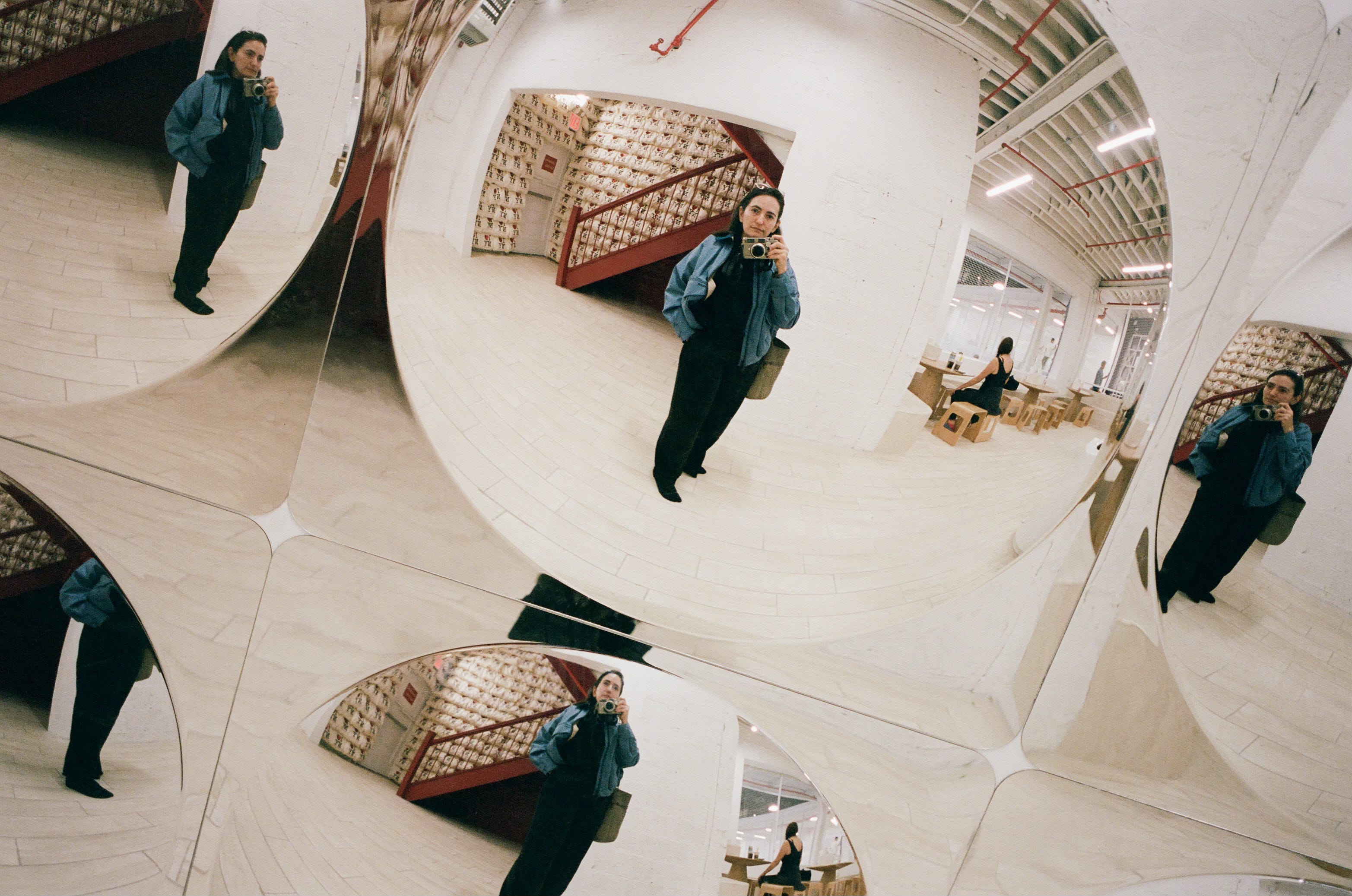
A quick note before the chat, I’ve been on a little hiatus from Substack while I’ve been wrapping up a book project (check it out!) and I’ve paused paid subscriptions until I’m back fully early this summer. But I’m breaking in now just to share this great interview with Katie Ward.
Katie Ward is a New York based portrait photographer and art director. She’s known for creating striking portraits that are both whimsical and timeless. Her work has been published by Vogue, Vice, People, The Jewish Museum, Heartful Magazine, and many others. Ward began her photography journey in photojournalism, where she worked for and studied under Burt Glinn, the former CEO of Magnum. She has a master's in contemporary art and photo history. Throughout her career, Ward has produced arts and culture programming for PBS, worked as the director of a contemporary art gallery on the Lower East Side, and created one of the original dog influencer accounts with her late French Bulldog Pickle (@picklebeholding), among other things. It’s this varied and cultured past that has led her to great success in blending current culture and fashion with the unique tastes of her clients in order to create the striking photos that she is known for. Born and raised in NYC, she lives in Queens with her husband, 2 kids, and standard poodle.
Before we get into a conversation about ADHD and creativity, tell me about your work. What do you create?
I’m an editorial portrait photographer who blends lifestyle and documentary photography to create what has been called “classically modern” portraits. I work with individuals, teams, companies, and families.
What has been a successful recent project?
This is hard to put a finger on, because sometimes my projects take years before they are published or considered successful. In the last two years, I’ve worked with a couple of authors who have used my photos for their book jackets and for features in magazines like Vogue. But, as someone who struggled to keep a traditional job—either due to the job market, the industry I was in, or my ADHD—my biggest success is keeping my business open and profitable for almost a decade.
And what are you looking forward to this year?
Since starting my business in 2018, I’ve been slowly working to develop my unique point of view and voice. I finally feel confident in my ability to consistently produce images that I’m proud of and feel like me. So, I’m excited to really step into my power and confidence this year with all the clients that I work with.
Let’s talk about ADHD and creativity. When did you discover you had ADHD, and what prompted or led to that discovery?
When I was 30, my therapist diagnosed me after I told her, “I need to write this down so I don’t forget.” I thought it was something everyone did, but clearly, most people don’t need to write down to remember to drink enough water.
Would you describe yourself as primarily inattentive, hyperactive, impulsive, or a mix?
Definitely inattentive. I was the little kid who would forget they were playing a team game of soccer and go pick flowers.
Did you expect the diagnosis—was it not surprising—or was it a lightbulb moment that suddenly made everything seem to make sense?
I absolutely did not expect it. It wasn’t something I was thinking about or looking to have diagnosed, and in 2016 there wasn’t a lot of chatter about ADHD in women the way there is now. I wasn’t there for an evaluation; it was just a casual comment by my therapist that was a revelation. The diagnosis has helped me to understand myself better but has also brought up a lot of anger at the missed support and opportunities that other members of my family received as kids. I was even evaluated as a child, and they missed the diagnosis, since women with inattentive ADHD weren’t widely recognized in the 90s.
Do you think of your diagnosis as a sort of watershed moment that divided life into the before knowing and the after knowing?
For me, the watershed moment was the day I found the right medication. The first day I took Concerta was a revelation, an “oh, I was in first gear trying to go 60mph.” That’s really when everything clicked, and I realized a few things. First, that I actually had the capacity and potential others had seen in me over the years. The “missed potential” was a constant source of heartache because of the continual and consistent disappointment of promises unmet and potential wasted. The second was a deep sadness and anger at the loss of decades of support and possibly careers and opportunities I never had. And the third was a lightness, an opening up, to possibilities that seemed impossible. And, for the first time in my life I had the kind of confidence that I’d always envied in others. And I’ve really been able to create a business and show up for my clients and myself in a reliable and authentic way.
What was your initial emotional response to discovering you had ADHD? Has that changed over time?
My emotional response really fluctuates. When I was first diagnosed, there was a bit of wonder and clarity about it, as well as the real anger in being let down. Now there is acceptance since I’ve found a career that I thrive in. I see how my ADHD has shaped my capabilities, and all of my special interests over the years has led me to a place where I’m able to offer my clients an experience that not many others can or want to do. Although perimenopause has really been kicking my butt. My meds have been less effective even after I went on HRT. So there’s definitely a bitterness at the struggles that others don’t have.
Do you consider the experience of being diagnosed with ADHD transformative in any way?
Not really. No.
What’s the least and most helpful advice you’ve been given?
My cheeky answer is that “don’t beat yourself up” is both the best and worst advice. Because, if I don’t beat myself up, I don’t get anything done, but learning to give myself grace and take it easier on myself has also allowed for a more creative and spontaneous practice.
My non-cheeky answer is, the worst advice I’ve gotten is, “You just have to do the thing.” I don’t know how to explain it to someone without ADHD, but sometimes you just can’t, and you just can’t for a long time, and I don’t know how to fix it or make it better. But the guilt sure doesn’t help.
The most helpful advice/insight I’ve been given is to stop victimizing myself. As harsh as this sounds, we are in a day and age where it’s so easy to play the victim, and it’s actively encouraged. I’ve found, for me, that this mindset has held me back in my work and personal life, and is also isolating. Have I been through hard/difficult things? Yes! Everyone has. Life is hard. But, I think we’ve all been forgetting that “It’s the hard that makes it good.”
Are there any self-care practices that, for you, ease difficulties associated with ADHD in general or with creating in particular?
Right now, I’m coming out of about four months of almost a complete breakdown of executive function. It was a mix of burnout and needing medications tweaked. I am 41. I was on HRT for two years, but it stopped being effective. When I first started it, it was like a light switch, I felt back to normal, and lost days, where I was just frozen, were few and far between. Over the last few months, I was only having bad days and worse days due to extreme hormonal fluctuations. My ADHD meds helped a little, but not enough. So, we decided to switch from HRT to birth control, and so far, the change has been surprisingly great. Other than making sure my mental health is taken care of, I’ve made an effort to have creative practices that are not my job. Things that I can just be bad at and have fun with, so for the last year, I’ve been taking ceramics classes. I’ve only made a set of cups, but it’s been a lot of fun. The freedom to create and to fail without consequence has lightened the creative load in my job.
What do you think are the biggest misconceptions people have about ADHD?
I think a lot of these misconceptions are being openly talked about by professionals who can better explain them than I can. What I think could be talked about more is the hurt that others can feel when our ADHD symptoms are out of our control, and taking responsibility for that. The diagnosis is a tool to help us learn about ourselves and grow, but I think a lot of people (myself included) use it as an excuse for hurtful behaviors. Like always, forgetting the things that are asked of you, or never fully finishing a task—like cleaning the kitchen—but then that task gets left for someone else. Over time, these seemingly small mistakes can cause big hurt.
Do you have a working routine, or do you find a routine to be incompatible with your experience of ADHD?
I have two kids—five and nine—so I’ve had to implement a working routine. Does it work every day? No. I generally schedule work for myself between 10 am and 4pm. Sometimes I’ll sit down and have a really productive day, others I won’t. I’m naturally a night owl and get my best work done late at night, but because I’m up at 5 to get the kids up and to school, I can’t work late without risking severe burnout.
Once you knew you had ADHD, did you alter or attempt to change your working process in order to accommodate your new understanding of the way your brain works?
No, but I have been trying to outsource tasks that I struggle with.
Do you believe ADHD gives you an edge creatively? If so, in what ways?
My job as a photographer is to notice things, all the things, all at once. I need to make sure my subjects are comfortable and relaxed, and posed correctly, that their clothing and hair are in place, that the background is good, and, most importantly, I need to have the ability to see beyond what we’ve planned. Noticing those spur-of-the-moment opportunities, or being able to quickly sell an idea that I know will work while the shoot is happening, is one of the best parts of my ADHD. It’s walking around the Upper East Side with a client, seeing a DARK red fragrance store, and knowing that the photos there are going to make the shoot. Or doing a portrait session with a client in the fluffiest tuille dress and remembering the YooHoo in the fridge, and knowing how cheeky it would be instead of the typical fancy glass of booze.


What aspects of your practice does ADHD complicate or make more difficult, for example, choosing or sticking with a topic, keeping a routine?
Consistency and follow-through are the overall themes that I struggle with. It looks like doing blog posts once a week and email blasts once a month for six months, then being unable to do them again for four to five months. Or getting behind on editing because I haven’t managed to fold laundry for three weeks, and for some reason I can’t do one without doing the other first.
Do you have a top five list of the biggest challenges, in your practice?
1. Marketing/social media—it’s not my personality to sell myself this way. I just want to make beautiful and whimsical pictures and call it a day.
2. Outreach—similar to #1, but reaching out to photo editors for editorial work feels like an imposition. A lot of imposter syndrome shows up when I try to do this.
3. Timelines—I struggle to find the time to sit down and edit. I always feel I should be or need to be doing other things, so I find that I’m behind on deadlines.
4. Dealing with difficult or disappointed clients—I’ve gotten very good at managing and problem-solving for these clients so that they feel seen and cared for, but it’s definitely an emotional challenge when a client is disappointed. I feel like a failure, and sometimes I can’t get out of my own head, thinking that I’m the problem.
5. Finding a team—I’ve been working for years to find a consistent team to work with. I have a good network now of hair and makeup artists, wardrobe stylists, prop stylists, and assistants, but I really want to have a regular group of professionals where we work together frequently enough that we are just in a groove together.
Have you learned anything that helps with those issues or developed your own workarounds?
Outsourcing what I can, being patient with myself, and knowing that if I actively work on these problems, I will come up with solutions. It’s the ignoring and thinking they will resolve on their own that doesn’t work.
Do you find that your ADHD affects the other parts of running your creative business? Where do you find it the easiest and hardest?
ADHD affects every part of my business; how could it not? I think that it’s a huge asset when talking to clients, because it enables me to understand who they are and to get to the point quickly. To take all the different parts of a person: where they are from, what they like to wear, where they live, what they do, what they want to be doing, what their hobbies are, how they’ve decorated their house, their favorite designers, etc … and understand what they need in a photoshoot. How they should dress, where their shoot should take place, the mood, the colors, and then clearly communicate all of that to them so they feel seen and accepted. The hardest part are the menial day-to-day tasks like bookkeeping, and actually scheduling time to sit down and work during the day.


Do you believe ADHD has affected your overall career?
This is a difficult one to answer. Do I think that if I had been diagnosed earlier and had the proper support from a young age that things would be different. Yes. I might have had more support with understanding social cues, learning to meet deadlines, and following through. Yet my ADHD is why I have the ability to quickly amalgamate all of the relevant aspects of my clients’ personal and working lives, boil that down to a point of view, and create meaningful photos for them. I also think that no matter what, when starting perimenopause things would go upside down for me.
If you were late diagnosed, how do you think your career might have been different if only you’d known you were neurodivergent? If so, do you experience any feelings of grief or regret about that?
I’ve dwelled on this so much, and felt so much pain from the fact that my late diagnosis really held me back socially and professionally, that I had to make a decision to let go and move forward, because I can’t change the past. I’m not going to engage in being a victim, because all it does is make me feel stuck and angry. Instead, I’m grateful that I have a care team that is helping me manage my ADHD and an extremely fulfilling career that I never thought I would be able to have.
All artists face rejection, and most on a regular basis. And while it’s not fun for anyone, people with ADHD often experience it acutely. If that’s your experience, how do you cope? What keeps you putting yourself out there?
I’ve grown a thick skin when it comes to certain kinds of rejection. I’m too expensive? Totally fine. I’m not the style you want? Also fine. We don’t get along? That’s ok. You want me to photograph in a different style? Go find someone who works in that style. You want to work with me, but only want work-for-hire, go find someone else.
Where I really struggle with rejection is when that rejection makes me feel inadequate. So, cold emailing photo editors is really hard because what if I’m not cool enough? What if this dream of working for a specific publication is squashed? So, submitting to open call submissions or portfolio reviews brings up feelings of inadequacy because if I’m not selected, it must mean I’m not a good enough photographer.


If you could recommend just one thing for people with ADHD— a book, a podcast, a Substack, whatever—what would it be?
Knitting. It’s a hobby I’ve had since I was a kid, and the repetitive movements help me to concentrate and clear my mind. I was definitely the weird kid in class, knitting so that I could focus.
Finally, if you could give up your ADHD, would you?
No. I wouldn’t. I’m at a place where I’ve accepted all parts of myself. Of course there are things that I want to do better, and am working on them, but I don’t know that I would be as successful without all of the different special interests that I’ve put together to create the client forward, bespoke experience, I don’t know that I would be as successful as I am.
Learn more about Katie at her website and follow her on Instagram.


Great post, Kate! Such a compelling example of how a diagnosis can make a huge difference in both positive and negative ways. I find it interesting that Katie mostly feels positive about her ADHD and how it has contributed to who she is.